International Symposium "Architecture of the Past: Inspiration for the Future"
The international symposium "Architecture of the Past: Inspiration for the Future" was held on September 19 and 20, 2024, at the National Institute of Art History (INHA).
The two-day conference convened a diverse group of specialists, including archaeologists, architects, historians, ethnologists and artisans, to present their work and research on architectural practices and structures relevant to current and future environmental, social and economic challenges. The objective was to demonstrate that the architectural design of the future can draw inspiration from solutions of the past, whether sophisticated or vernacular, irrespective of the materials, historical periods, or geographic regions from which they originate.
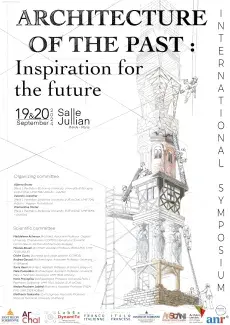
Architecture of the Past: Inspiration for the Future
The evolution of architecture, in response to universal needs, has resulted in diverse forms across a variety of settings, thereby offering a multitude of solutions. This diversity in the forms of built structures and inhabited spaces is of interest to many disciplines, yet opportunities for interdisciplinary collaboration are limited. The objective of this interdisciplinary event will therefore be to bring together archaeologists, historians, architects, artisans, curators, conservators, and ethnologists in order to share their work and research on architectural practices and structures that are relevant to current and future environmental, social, and economic challenges. The goal is to demonstrate that the architecture of tomorrow is also shaped by the past—whether scholarly or vernacular—regardless of materials, historical period, geographic region, or cultural sphere.
Please find below a list of the main topics to be explored. Please note that this list is not exhaustive and is applicable to all periods and geographic areas.
Adapting to an unstable environment (seismic, volcanic, prone to flooding, etc.); to climate change; to specific constraints (arising from the urban fabric, topography, etc.); reinforcing buildings to make them sustainable; addressing major risks, whether natural or man-made; limitations and relevance of the approach
Blending into the landscape without spoiling it; to preserve, restore and renovate existing buildings rather than demolish them; to design architecture that is rooted in and adapted to its environmental and social context.
Bio- and geo-sourced, recycled and reused materials to minimise carbon footprint; the use of vernacular materials (earth, wood, stone, plaster, straw, etc.); the challenge of harnessing the physico-chemical and mechanical properties of materials; methods for applying biomimicry, new technologies and ‘paleo-inspiration’; the technical, economic and legal challenges associated with these materials.
Users and builders, in terms of housing types, ways of living and the functionality of spaces; the role of builders and how expertise is passed down over time, balancing continuity, loss and restoration; working with local communities to preserve architectural traditions; positive and negative perceptions of different architectural styles.
In conclusion, a Round Table will be convened to summarise the key issues that were raised during the course of the conference. This will be followed by a discussion addressing the limitations and prospects of the past as a source of inspiration, future challenges at the intersection of tradition and modernity, and, more generally, the complementary nature of our disciplines.
Organizing Comittee:
Alberto Brutto (Paris 1 Panthéon-Sorbonne University, Bologna Alma Mater, EUR ArChal, UMR 7041 ArScAn GAMA)
Valentin Loescher (Paris 1 Panthéon-Sorbonne University, EUR ArChal, UMR 7041 ArScAn Protohistoire égéenne)
Clémentine Martal (Paris 1 Panthéon-Sorbonne University, EUR ArChal, UMR 8096 ArchAm)
Scientific Comitee:
Maddalena Achenza (Architect, Associate Professor, Università di Cagliari, Présidente de l’ICOMOS International Scientific Committee on Earthen Architectural Heritage)
Mounia Bouali (Architect, Associate Professor, ENSA PVS, UMR 7218 LAVUE)
Claire Cornu (Architect and Urban Planner, ICOMOS)
Andrea Gaucci (Archaeologist, Associate Professor, Università di Bologna)
Sarra Kasri (Architect, Associate Professor, UMONS, Belgique)
Maia Pomadère (Archaeologist, Associate Professor, Paris 1 Panthéon-Sorbonne University, UMR 7041 ArScAn)
Haris Procopiou (Archaeologist, Professor, Paris 1 Panthéon-Sorbonne University, UMR 7041 ArScAn, EUR ArChal)
Nadya Rouizem Labied (Architect, Associate Professor, ENSA PVS, UMR 3329 AUSser)
Eleftheria Tsakanika (Engineer, Associate Professor, National Technical University of Athens)